

The Union government on Tuesday introduced the Taxation and Other Laws (Amendment) Bill, 2026 in the Lok Sabha, proposing changes to multiple laws to improve the ease of doing business, attract foreign investment and support the Make in India initiative. Finance Minister Nirmala Sitharaman tabled the Bill, which seeks to amend the Payment and Settlement Systems Act, 2007, the Income Tax Act, 2025, and the Finance Act, 2026.
Also Read: MSME Development Bill Cleared by Rajya Sabha Despite Uproar
Tax Relief Proposed for Data Centres and Foreign Investors
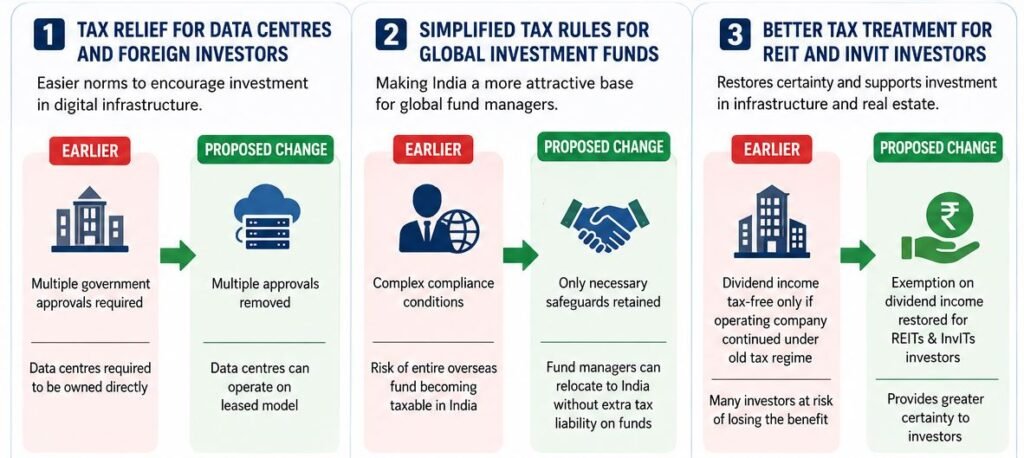
A key provision of the Bill offers tax relief for foreign cloud companies using Indian data centres. The proposed amendments remove several government approval requirements that were earlier linked to the exemption. The Bill also allows Indian data centres to operate on a leased model, replacing the earlier requirement of direct ownership, a move aimed at encouraging investment in digital infrastructure.
Fund Managers May Find India More Attractive
The proposed legislation also seeks to simplify tax rules governing global investment funds. According to the Finance Ministry, existing compliance conditions discouraged foreign fund managers from operating from India due to concerns that the entire overseas fund could become taxable in the country. The Bill proposes to retain only safeguards necessary to prevent misuse and round-tripping of funds while allowing fund managers to relocate to India without triggering additional tax liabilities for foreign funds.
Also Read: India Crossed One Billion Tonnes of Coal Production After Commercial Mining Reforms
The Bill also addresses taxation of Real Estate Investment Trusts (REITs) and Infrastructure Investment Trusts (InvITs). Under the existing framework, dividend income remained tax-free only if the operating company continued under the old tax regime. With many companies shifting to the new tax regime, investors faced the possibility of losing this benefit. The proposed amendment restores the exemption, providing greater certainty to investors while supporting India’s broader investment and infrastructure development agenda.
Also Read: Patanjali Expanded into Insurance and Renewable Energy
3 thoughts on “Finance Minister Nirmala Sitharaman Introduced the Taxation and Other Laws (Amendment) Bill, 2026 in Parliament”
Comments are closed.