

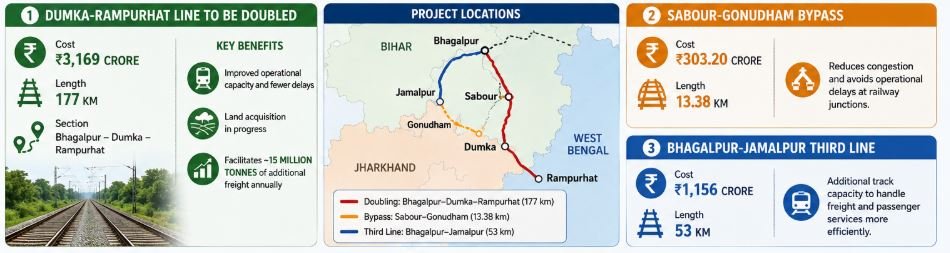
The Railways has approved infrastructure projects worth around 4,600 crore aimed at improving rail connectivity across Bihar, Jharkhand and West Bengal. The package includes doubling of the 177 km Bhagalpur-Dumka-Rampurhat railway line, construction of a bypass between Sabour and Gonudham, and a third line between Bhagalpur and Jamalpur. The projects are expected to increase line capacity, ease congestion and improve passenger and freight movement across the three states.
Also Read: India Crossed One Billion Tonnes of Coal Production After Commercial Mining Reforms
Dumka-Rampurhat Line to Be Doubled at 3169 Crore
The Railways has sanctioned 3169 crore for doubling the 177 km Bhagalpur-Dumka-Rampurhat single track route. The project is expected to improve operational capacity and reduce delays caused by limited track availability. Land acquisition for the project is also being expedited. Once completed, the additional track is expected to facilitate smoother train operations between Bihar, Jharkhand and West Bengal.
Also Read: Tata Steel Planned Major Expansion in Tinplate, Tube and Wire Businesses
Better Access to Pilgrimage Centres
The upgraded route is expected to provide a more direct rail link towards Howrah through Dumka and Rampurhat. At present, several trains travelling from Bhagalpur towards Howrah take the Malda route, resulting in longer journeys. Improved connectivity will also benefit passengers travelling to major pilgrimage centres such as Deoghar, Basukinath and Tarapith. The additional line capacity is expected to facilitate around 15 million tonnes of additional freight movement annually.
Also Read: MSME Development Bill Cleared by Rajya Sabha Despite Uproar
Third Line and Bypass to Ease Congestion
The Railways has also approved a 13.38 km Sabour-Gonudham bypass at a cost of 303.20 crore to reduce congestion and avoid operational delays at railway junctions. Separately, 1,156 crore has been sanctioned for a 53 km third line between Bhagalpur and Jamalpur. With additional track capacity, freight and passenger services can be handled more efficiently, potentially allowing faster movement of express and superfast trains and creating scope for additional services.